
The Cost of Hiring an Employee in 2026: The Shocking Hidden Math
The cost of hiring an employee is the number most founders get wrong. It's the start of a new financial year, you're staring at your burn rate, and you keep asking the same question: "Can I afford to hire?"
Here's the problem with that question. You're probably calculating the visible cost (the salary) and missing the seven or eight other costs that come bundled with every full-time hire. By the time you add them up, the true cost of hiring an employee is often 60 to 80% higher than the salary itself.
Let's actually do the math, side by side, for a single mid-level operations hire in 2026. If you are still weighing whether delegation makes sense at all, our breakdown of the reasons to hire a virtual assistant covers the operational case. This post is purely about the money.
The Real Cost of Hiring an Employee at $3,000/Month
Here's the full picture for a single operations or admin hire on a $3,000 monthly salary:
| Cost Component | Monthly |
|---|---|
| Base salaryThe number on the offer letter | $3,000 |
| Benefits, insurance, statutory contributionsRoughly 12-15% of salary | $420 |
| Office space, utilities, equipmentAllocated per employee | $350 |
| Software, tools, licensesCRM, productivity, comms | $120 |
| Recruitment fee (amortized)15-25% of CTC, spread over 12 months | $450 |
| Training & onboarding (months 1-3)Reduced productivity, ramp-up cost | $300 |
| Paid leave, holidays, idle time~22 days/year on payroll, not working | $275 |
| Attrition risk & replacement bufferIndustry avg 25-35% annual churn | $285 |
| True monthly cost of a $3,000 employee | $5,200 |
That's a 73% premium on the salary you thought you were paying. And we haven't even counted opportunity cost: the 40 to 90 days of founder time spent on hiring, training, and managing.
None of this is guesswork. Bodies like the Society for Human Resource Management have long documented that cost per hire and turnover expenses push the real cost of hiring an employee well past the salary line, and the U.S. Bureau of Labor Statistics reports that benefits alone make up close to a third of total employer compensation costs.
Where the Hidden Costs Actually Live
Every line in that table is a recurring expense, not a one-off. This is where the cost of hiring an employee actually hides, and why the salary figure misleads almost everyone who budgets from it.
Office Infrastructure
Rent, utilities, desk, chair, laptop, monitor, internet. Even in a hybrid setup, the per-employee allocation rarely goes below this.
Recruitment
Agency fees, job boards, internal HR time, screening rounds, background checks. Most founders forget this is a real expense.
Training & Ramp-Up
A new hire produces 50-70% of their full output in the first three months. You pay 100% from day one.
Attrition
BPO and admin role churn is brutal. Every exit means re-hiring, re-training, and a productivity reset for the team.
Idle Time on Payroll
Holidays, sick leave, casual leave, slow weeks. You pay the salary regardless of whether work happens.
Benefits & Compliance
Insurance, statutory contributions, gratuity, year-end bonuses. Mandatory, predictable, often forgotten in early-stage planning.
Now Run the Same Math for a Virtual Assistant
Here's the same role staffed through a dedicated VA at Verito:
That $1,040 is a full-time dedicated VA at 160 hours a month, the Enterprise tier on our virtual assistant pricing plans. Nothing sits behind it as a setup fee or an annual lock-in.
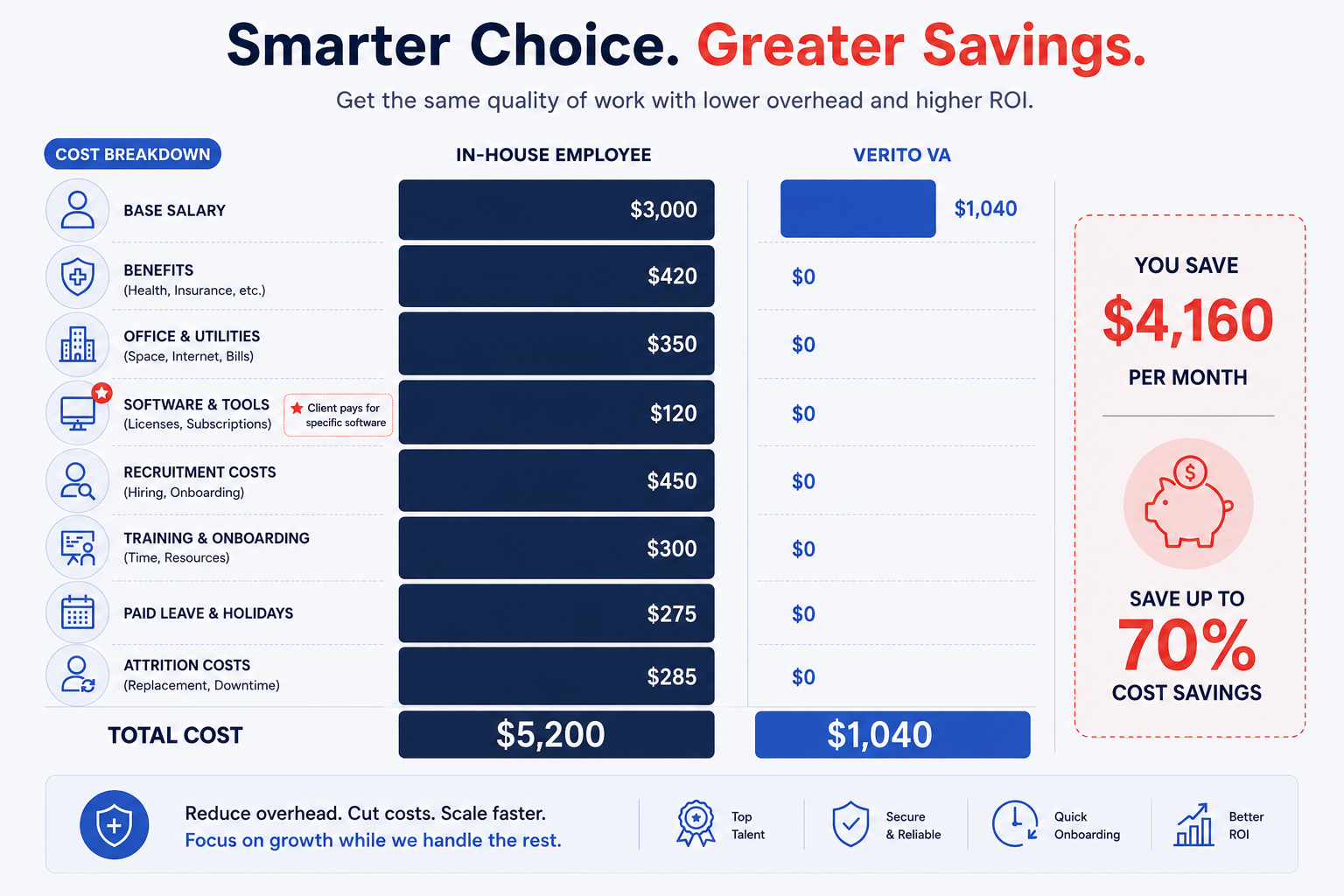
The gap: $5,200 vs $1,040 per month. That's $49,920 saved per role, per year, on a single seat. Put next to the full cost of hiring an employee in-house, the VA route covers an entire founder's salary once you multiply it across 3 to 4 operational roles.
This isn't theoretical. Industry data shows companies using VAs report an average 78% reduction in operating costs compared to in-house hires. Verito's own client average sits at 70%, conservatively.
The cheapest hire is not the one with the lowest salary. It's the one whose total cost, ramp time, and risk profile all stay low. In 2026, that's almost never a full-time employee.
When In-House Still Makes Sense
To be fair, none of this means the cost of hiring an employee is never worth paying. A full-time hire still makes sense when:
- The role involves deep IP or strategic decision-making. Senior product, engineering leadership, founding-team-level functions.
- The work needs constant physical presence. Lab work, manufacturing supervision, in-person client management.
- You're building a long-term cultural moat. Anchor employees who'll shape the next decade of the company.
For everything else (admin, customer support, lead generation, bookkeeping, e-commerce operations, insurance backoffice), the VA model wins on cost, speed, and flexibility. Almost every time.
Six Functions, One Reliable Partner
- Insurance Outsourcing: Claims backlog, policy admin, customer queries.
- Accounting & Bookkeeping: Daily books, reconciliation, payroll, reporting.
- Lead Generation: Research, outreach, CRM management, appointment setting.
- E-Commerce Support: Listings, inventory, order management, customer queries.
- Non-Voice Customer Support: Email, chat, ticket resolution, CRM updates.
- Remote Staffing: Dedicated VAs trained to your workflow in 48 hours.
Cost of Hiring an Employee: FAQs
What is the true cost of hiring an employee in 2026?
Why is the cost of hiring an employee higher than the salary?
How much can a virtual assistant save versus an in-house hire?
When does hiring an in-house employee still make sense?
How quickly can a virtual assistant replace an in-house role?
Final Thoughts
If you're budgeting for the new financial year, run the full cost of hiring an employee on every operational role you're planning to fill. Most of the time, the in-house premium isn't worth it.
The 2026 founder playbook is simple: keep the strategic roles in-house, delegate operations to trained VAs, and reinvest the savings into growth.
Want to see what those savings look like for your specific business? Explore our six service lines or write to [email protected] for a custom cost comparison.