Before Diving Into Marketing in the AI Era, Understand the Basics
Have you ever asked yourself: why isn't my product generating the profits it should? Why aren't sales increasing even with one of the best products in the segment? Why are competitors with fewer features reaching customers faster than you?
The answer is the same one it has always been: MARKETING. Without it, you can't sell a glass of water in a desert. And marketing in the AI era has raised the stakes even higher. With AI rewriting the rules of every industry in 2026, getting the fundamentals right has never mattered more. Let's go back to the basics, but with a 2026 lens.
The Fundamentals of Marketing
Here's the truth most marketers won't admit: marketing is science, not creativity.
Creativity has a role, but underneath every successful campaign sits a structured process: analyze, test, measure, refine. Like chemistry, you analyze the use case, mix the right channels (social, email, SEO, paid ads, content) in the right proportions, measure, and adjust if it fails. AI now lets you run dozens of these experiments in parallel and get results in hours, not weeks.
Good marketing isn't only about your product. It's about the entire category: competitors, customer needs, price sensitivity, market trends. Tools like ChatGPT and Perplexity have made this kind of analysis accessible to any small business with a sharp founder.
As management legend Peter Drucker put it:
The aim of marketing is to know and understand the customer so well that the product or service fits them and sells itself. The aim of marketing is to make selling superfluous.
Drucker also said marketing should be the responsibility of the managing leadership, not a separate function. Translation: founders shouldn't outsource the strategy. Lead it yourself, and delegate execution to a trained team (or an AI-fluent virtual assistant).
Marketing vs Sales: They're Not the Same
Founders often confuse marketing and sales. They're two stages of the same journey, not interchangeable.
Marketing Starts Early
Marketing begins at product analysis. Who is this for? What problem does it solve? How will people discover it? All before a single unit is sold.
Sales Closes the Loop
Sales enters only after the customer is ready to transact. It's the final step of the marketing cycle, where strategy converts into revenue.
Marketing builds the audience and the trust. Sales closes the deal. In marketing in the AI era, AI bridges the two like never before, from lead scoring to AI sales agents that handle initial conversations 24/7.
The Four Ps of Marketing
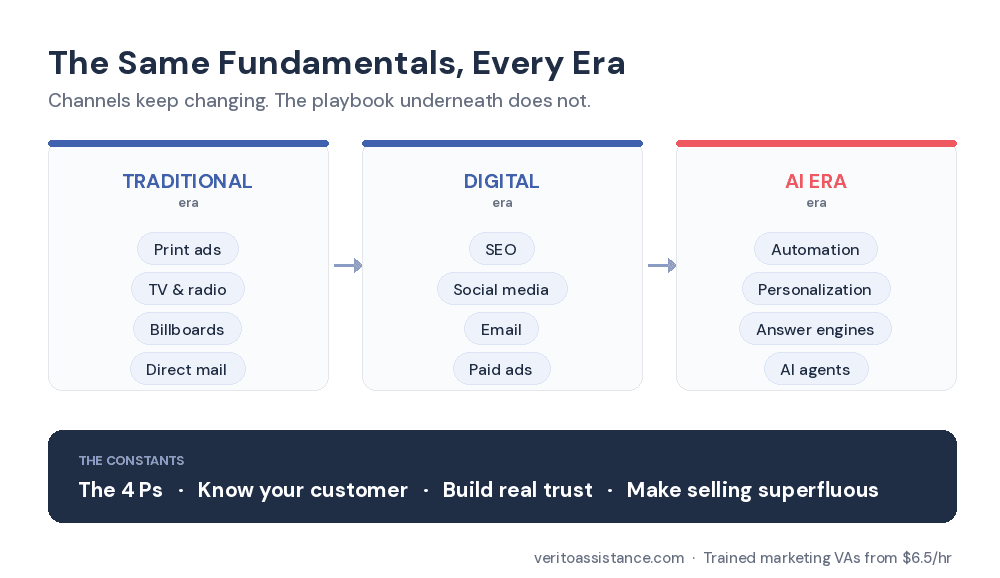
Once fundamentals click, the next layer is the four pillars, popularly known as the Marketing Mix. Decades old, still the backbone of every campaign, AI or not. Even in marketing in the AI era, the four Ps decide what you sell and to whom.
Product
Know your product inside out, and every competing product in your category. AI tools now scan thousands of competitor reviews in seconds, giving you research that used to take weeks.
Price
Pricing must cover costs and match what customers will pay. AI-powered tools analyze demand and competitor pricing in real time, making dynamic pricing the default for serious brands.
Promotion
Get the right product in front of the right people. AI-driven ad platforms now decide which creative to show to whom, often outperforming human-managed campaigns.
Place
Where can customers actually buy? Online, retail, marketplaces, your own site. AI-powered logistics let small brands offer same-day delivery, levelling the field with giants.
When the four Ps work together, a product becomes a brand, and eventually, a category essential.
Traditional vs Digital Marketing
Promotion happens through two channels: online (Digital Marketing) and offline (Traditional Marketing). The difference is the medium: where you reach your audience and how you talk to them.
| Aspect | Traditional Marketing | Digital Marketing |
|---|---|---|
| Channels | TV, radio, print, billboards | Social, email, SEO, Google/Meta ads, AI-generated campaigns |
| Reach | Broad, unfocused | Targeted, global, precise |
| Cost | High | Low to mid (AI driving it lower) |
| Interaction | One-way | Two-way, real-time |
| Results & Data | Delayed by weeks | Real-time, same-day |
| Flexibility | Rigid, expensive to change | Instant updates, one click |
TM still works for some audiences (luxury, premium real estate, B2B enterprise), but in marketing in the AI era the winning brands treat digital as primary and traditional as a strategic supplement, not the reverse.
Marketing in the AI Era: How AI Changed Everything
Step away from marketing in 2020 and return in 2026, and you'd barely recognize it. Marketing in the AI era isn't the old playbook with a chatbot bolted on. AI has rewritten how every layer works. In fact, McKinsey estimates generative AI could add up to $4.4 trillion in annual value, with marketing and sales among the biggest winners:
Where AI Is Reshaping the Stack in 2026
- Content & creative: ChatGPT, Claude, and Midjourney draft blogs, ad copy, and visuals in minutes, freeing teams for strategy and editing.
- Targeting & personalization: Meta Advantage+ and Google Performance Max decide who sees what, often outperforming human-managed audiences.
- Customer support: AI chatbots and voice agents handle Tier-1 queries 24/7, escalating only what truly needs a human.
- Market research: Perplexity and AI research agents pull competitor analyses and sentiment in minutes, not weeks.
- Predictive analytics: AI forecasts which leads will convert and which campaigns will scale, before you spend the budget.
AI doesn't replace marketers. It replaces tasks. The marketers who direct AI like a sharp junior teammate are pulling ahead. The smartest businesses are building AI-fluent teams, often by hiring trained virtual assistants who already know these tools.
The CATT Funnel
Now to one of the most elegant frameworks for digital marketing: the CATT Funnel, coined by digital marketing mentor Mr. Deepak Kanakaraju. Marketing is science, and science has formulas. This is the formula that maps how wealth is created online:
Pick the right niche, create useful content, capture attention, build trust, convert. AI accelerates every step, but the niche decision is still yours.
Personal Branding in the AI Era
Who do you trust more: a company logo, or a human face? In 2026, the answer matters more than ever. "The best known will always beat the best." Building a strong personal brand is now arguably more powerful than building a company brand alone.
Why personal branding wins in the AI era:
- Humans are trusted more than logos. With AI-generated content flooding every feed, people gravitate to real, identifiable humans behind the brand.
- Personal brands are AI-resilient. Your voice, story, and point of view can't be cloned by a competitor's prompt.
- If your company stumbles, your personal brand carries you. Founders with strong personal brands recover from setbacks far faster.
Elon Musk's personal brand has more reach than SpaceX, Tesla, and X combined. Sam Altman's posts on X move markets more than OpenAI's official press releases. MS Dhoni is the brand ambassador for dozens of products because his personal trust value is irreplaceable. The pattern is clear.
The 10 Golden Rules of Personal Branding
- Have a focus, pick one area you want to be known for.
- Be genuine, audiences sniff out fakeness in seconds.
- Tell a story, your story is what people remember.
- Be consistent, show up regularly even when it feels boring.
- Be ready to fail publicly, and learn from it.
- Create a positive impact in every interaction.
- Follow a successful example, but don't copy it.
- Live your brand, offline self should match online self.
- Let other people tell your story, word of mouth beats self-promotion.
- Leave a legacy, build something people reference even after you stop posting.
Personal branding pays compound interest. In marketing in the AI era, where machine-made content is everywhere, a real human brand is the one asset a competitor cannot copy. Start early, the return grows year by year.
Mass Trust: The Marketing Multiplier
Strong personal branding leads naturally to Mass Trust, the trust of a large group who genuinely believe in you. It's the second-most powerful asset in marketing (after the right niche), and personal branding is its blueprint.
To build mass trust, your communication must convince, connect, and close. Not fluent English, but the ability to write in a voice that feels like a one-on-one conversation, even when reaching thousands. AI can polish your drafts and personalize emails at scale, but the core voice has to come from you.
Integrated Digital Marketing
Integrated Digital Marketing (IDM) is exactly what the name implies: multiple digital techniques working together, amplifying each other. Not SEO alone, not email alone, not paid ads alone. All of them, in sync.
- Content marketing and research as the engine, the long-term asset that compounds.
- SEO so your content gets found in search and in AI answer engines like ChatGPT and Perplexity.
- Social media for distribution, conversation, and culture.
- Email marketing for direct, owned-audience communication.
- Paid ads (Google, Meta, LinkedIn) for amplification and targeted reach.
- Influencer partnerships to borrow credibility from established personal brands.
- AI tools and automation as the layer tying everything together and running while you sleep.
Each tactic alone has limited impact. Together they create an unmistakable presence, and that stacking effect is what marketing in the AI era rewards most. Brands that win in 2026 don't do one channel beautifully, they do five channels competently and have them reinforce each other. AI makes this possible even for small teams.
Marketing in the AI Era FAQs
What does marketing in the AI era actually mean?
Have the marketing fundamentals changed in the AI era?
What is the CATT funnel in marketing?
Do the four Ps of marketing still matter with AI?
How can a small business do marketing in the AI era without a big team?
Final Thoughts
Marketing is science. The four Ps are universal. Digital is the present. The CATT funnel maps how wealth is built. Personal branding compounds. Mass trust multiplies. Integration is the key. Get these seven right, and you're ahead of 90% of business owners trying to figure this out alone.
AI hasn't changed what marketing is. It has changed what marketing can do. That is the whole point of marketing in the AI era: the brands winning in 2026 understand both, the timeless principles and the modern tools.
Need help executing without a full in-house team? That is exactly what a trained remote marketing assistant is for, and it is what Verito Assistance does across all six service lines. Contact us or email [email protected], and we'll match you with a VA who lives and breathes modern, AI-powered marketing.