The $100,000 Insurance Agency Bottleneck Nobody Talks About
You have looked at the marketing spend. You have looked at the lead sources. You have wondered whether the carriers are the problem. So here is a question worth sitting with: what is actually stopping your agency from writing more business?
For most agencies, it is not any of the obvious suspects. It is the service work. The certificates, the endorsements, the policy checking, the data entry, and the renewal prep that pile up faster than your team can clear them. No single hour of it feels like a crisis, so nobody names it. Add those hours up across a year and a typical small-to-mid agency is quietly losing around $100,000. This is the insurance agency bottleneck almost nobody puts a number to.
Let's actually put a figure on the insurance agency bottleneck, and then talk about the fix. If you already know the problem and just want the shape of the solution, our insurance back office support page covers what the work looks like day to day.
Where the Insurance Agency Bottleneck Hides
The number is not one big expense you could spot on a report. It is four smaller ones that never get totaled up. For an agency with a handful of producers and a couple of service staff, a realistic year looks like this:
| What it costs you | Per Year |
|---|---|
| Producer selling hours lost to service work6 to 8 hours a week pulled off selling and onto admin | ~$45,000 |
| Overtime, burnout, and service-staff turnoverRehiring and retraining people who leave overloaded | ~$15,000 |
| Slow turnaroundRenewals and referrals lost to a growing backlog | ~$20,000 |
| Rework and E&O exposureMistakes made by rushed, overloaded staff | ~$20,000 |
| The bottleneck, per year | ~$100,000 |
The reason it hurts is that none of it shows up as a single line on your P&L. The biggest piece, the new business a producer would have written with those hours back, is a cost you never see because it was never booked.
Where the Hidden Costs Actually Live
Six pressures create the insurance agency bottleneck, and each one feeds the next. Read them together and the $100,000 stops looking like an exaggeration.
Producer Time Drain
Certificates, endorsements, and data entry pull your best closers off selling and onto paperwork nobody bills for.
Slow Turnaround
When service lags, renewals and referrals quietly leak out the back door. Clients rarely tell you why they left.
Burnout & Turnover
Overloaded CSRs leave. Every exit means rehiring, retraining, and a full service reset for the accounts they held.
E&O Exposure
Overloaded people in a hurry make the mistakes that turn into errors-and-omissions claims. One is enough to wipe out a year of savings.
Local Hiring Cost
A local CSR takes 60 to 90 days to find and costs far more than the salary line once you add benefits, taxes, and overhead.
The After-Hours Gap
Your backlog sits untouched overnight, while agencies with offshore support walk in every morning to cleared queues.
Now Run the Same Math for an Insurance VA
The fix is not to make your team work harder. It is to move the repeatable service load off your producers entirely, to a trained offshore team built for exactly this work. Here is what that same capacity costs:
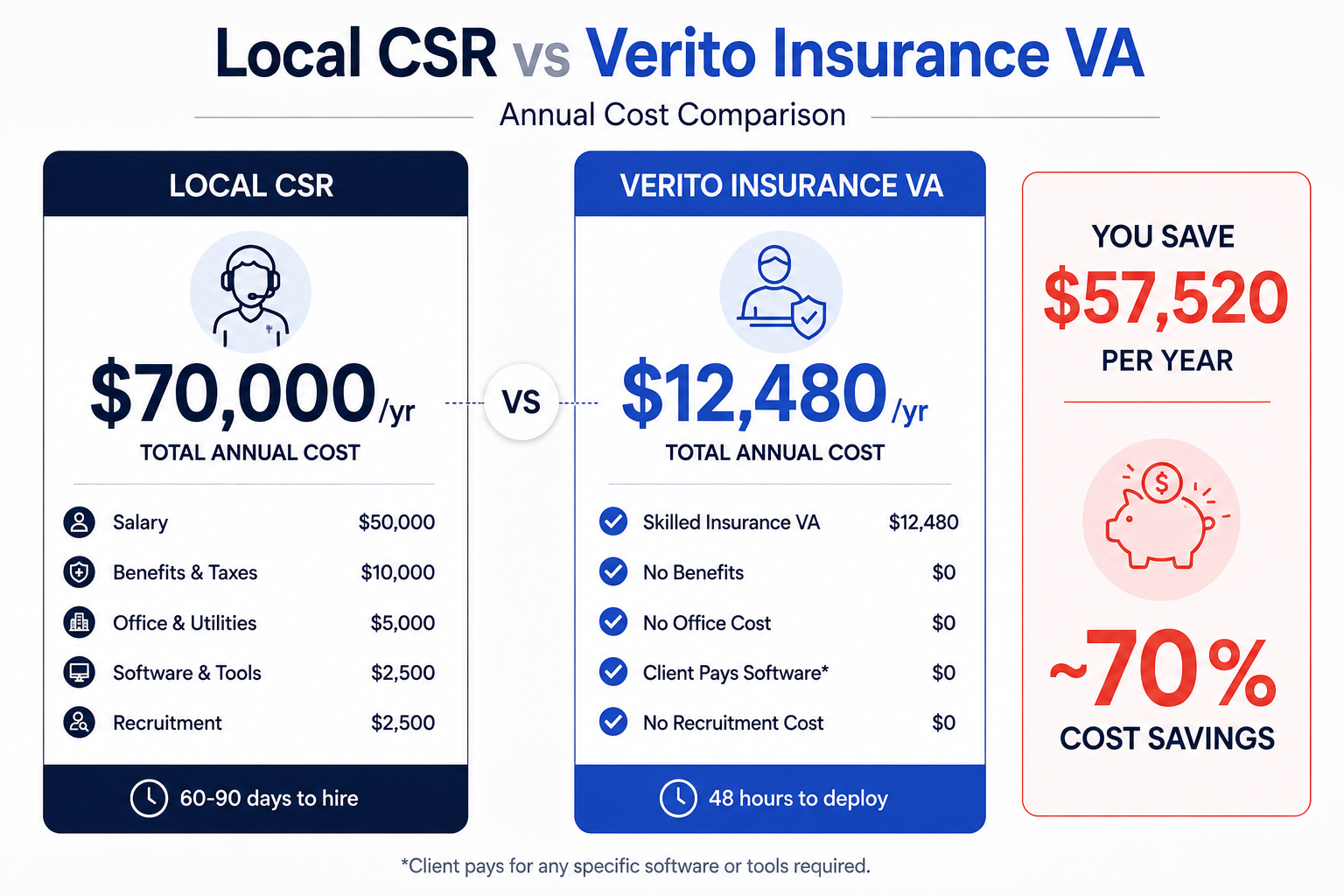
Compare that with the local route. A CSR to clear the same work runs roughly $70,000 a year once you load in benefits, taxes, software, and office cost. The trained Verito VA runs about $12,480 a year at $1,040 a month, which is the dedicated tier on our virtual assistant pricing plans. Same work moved off your producers, at roughly 70% less cost. The insurance agency bottleneck stops being a leak and starts being your margin.
The agencies that pull ahead are not the ones with the most leads. They are the ones whose producers spend the day producing, because someone reliable is handling the paperwork in the background.
When Keeping It In-House Still Makes Sense
To be fair, solving the insurance agency bottleneck does not mean sending everything offshore. Keep it in-house when:
- The work is relationship-driven producing. Winning accounts, reading a client's real needs, and closing belong with your licensed producers.
- It needs licensed judgment or binding authority. Coverage decisions and anything requiring a license stays with the people who hold one.
- It is high-touch claims advocacy. The moments where a client needs a human who knows their story are worth keeping close.
For everything repeatable, though, the offshore model wins on cost, speed, and reliability. Almost every time. The same logic applies well beyond insurance, which is why agencies often extend it into accounting and bookkeeping and non-voice customer support once the first seat proves itself.
The Service Load a Trained Insurance VA Handles
- Certificates & COIs: Issuance, tracking, and renewals of certificates of insurance.
- Policy Administration: Endorsements, policy checking, ACORD forms, and AMS data entry.
- Renewals & Remarketing: Renewal prep, requoting, and loss run requests.
- New Business Support: Quote prep, application data entry, and carrier submissions.
- Client Service: Email and chat query handling, COI requests, and carrier follow-ups.
- Account Maintenance: Endorsement tracking, document management, and CRM updates.
Every one of these is covered under Verito's insurance outsourcing services, handled inside your own AMS by a VA who already knows the workflow.
Insurance Agency Bottleneck FAQs
What is the insurance agency bottleneck?
How much does it cost to hire an insurance VA?
Is outsourcing insurance back-office work secure and compliant?
How quickly can an insurance VA start?
What insurance software can a VA work in?
Final Thoughts
The insurance agency bottleneck is real, but it is not inevitable. It exists because service work has nowhere to go except onto the people you most need selling.
Give that work a home. Keep your producers producing, hand the repeatable load to a trained team, and reinvest the savings into growth. That is the whole play.
Want to see what it looks like on your own backlog? Explore our insurance support service or write to [email protected] for a custom breakdown.