AI Won't Replace Your Virtual Assistant in 2026. But an AI-less VA Will Be Replaced
If you Googled "will AI replace virtual assistants" in 2025, you found a million scary headlines. Here's the truth that almost no one is saying out loud: AI isn't replacing virtual assistants. It's replacing the ones who refuse to learn it. The hire that wins in 2026 is the AI virtual assistant, a VA who runs the tools instead of competing with them.
The numbers back it up. The global VA services market is projected to grow from $19.5 billion in 2025 to $55.4 billion by 2035, a 184% jump. Demand is exploding, not collapsing. But the kind of VA businesses want has changed dramatically.
AI Replaces Tasks, Not Roles
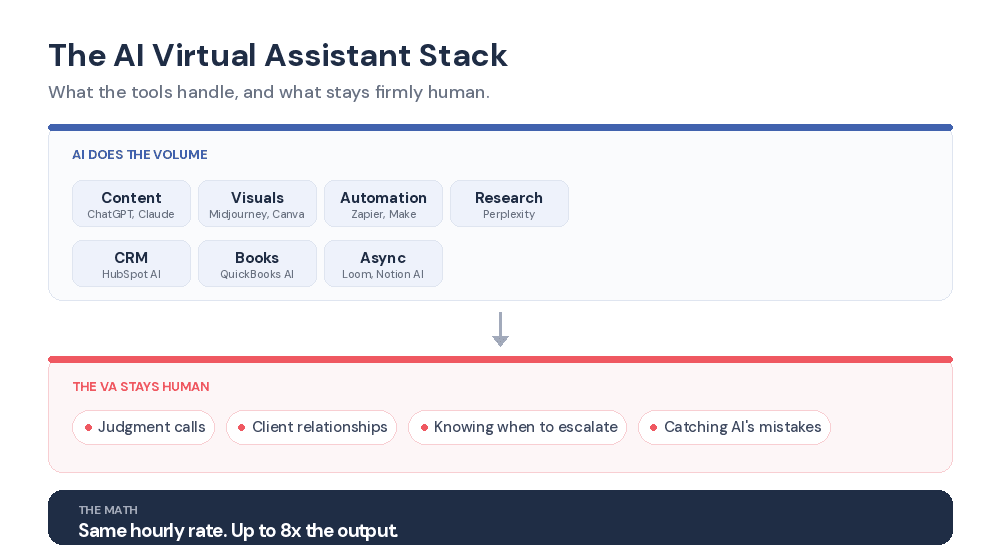
This is the misunderstanding at the heart of every "AI vs jobs" panic. AI is good at tasks: drafting emails, summarizing meetings, categorizing leads, scheduling, writing first drafts. It is not good at roles: managing a client relationship, judging when something needs escalation, navigating a difficult vendor, or knowing your business's quirks.
A virtual assistant who can wield AI as a tool gets ten times more done than one who doesn't. Research backs this up: an NBER study of 5,000 support agents found that AI assistance raised productivity by 14%, and by 34% for less experienced workers. AI did not replace them. It made them better. But the judgment, the context, the human handoff, that still comes from the VA. That is exactly what an AI virtual assistant brings to the table.
The Same Task. Two Different VAs.
Here's what the gap actually looks like, using a real example from lead generation:
4 hours of work
- Manually searches LinkedIn for 50 prospects
- Copies each into a spreadsheet
- Writes one outreach template, sends it to all
- Manually logs replies into CRM
30 minutes of work
- Uses an AI prospect-finder to pull 200 verified leads
- Generates 5 personalized email variants per segment
- Auto-syncs replies into CRM via Zapier
- Reviews and corrects the AI's judgment calls
Same outcome category. Eight times the output. Same hourly rate. The math isn't subtle, and founders who notice it first win.
7 Skills Every AI Virtual Assistant Should Have in 2026
If you're hiring in 2026, the bar has moved. Here is what an AI virtual assistant actually looks like in practice:
Content with ChatGPT & Claude
Drafting emails, blog outlines, social posts, and meeting summaries with prompt skill, then editing for voice and accuracy.
Visuals with Midjourney & Canva AI
Generating brand-consistent graphics, product mockups, and social creatives without a designer for every task.
Automation with Zapier & Make
Connecting your CRM, email, calendar, and storage so repetitive handoffs run themselves.
Research with Perplexity
Pulling competitor analyses, market data, and sourced briefs in minutes instead of hours.
CRM Intelligence (HubSpot AI, Salesforce Einstein)
AI-assisted lead scoring, follow-up timing, and pipeline hygiene that drives 30% faster lead response.
Bookkeeping AI (QuickBooks, Xero AI)
Auto-categorizing transactions, flagging anomalies, and turning bank feeds into clean books faster.
Async Communication (Loom AI, Notion AI)
Capturing meetings, generating action items, and keeping distributed teams aligned without endless calls.
The best VA in 2026 isn't the one who works the most hours. It's the one who turns every hour into four by orchestrating AI alongside their own judgment.
What This Means If You're Hiring in 2026
If you're interviewing VAs this year, ask these three questions:
- "Walk me through your last week using AI tools." A real answer mentions specific tools and specific outcomes. A vague answer is a red flag.
- "Show me a workflow you've automated." Even a simple Zap counts. No workflow at all means they're still doing 2020-era manual work.
- "Tell me about a time AI got it wrong and you caught it." The best VAs treat AI as a sharp but careless intern. They don't blindly trust it.
AI-Trained VAs Across All Six Service Lines
At Verito, every AI virtual assistant we deploy is trained on the AI stack that matters for their function:
- Lead Gen VAs work with Perplexity, ChatGPT, and CRM AI for faster outreach.
- Insurance VAs use AI document parsing for claims and policy admin.
- Bookkeeping VAs run AI-assisted reconciliation in QuickBooks and Xero.
- E-commerce VAs generate product listings and respond to queries faster.
- Customer Support VAs handle tickets with AI-suggested replies and routing.
- Remote Staff get AI-fluency as a baseline, not an upgrade.
AI Virtual Assistant FAQs
What is an AI virtual assistant?
Will AI replace virtual assistants entirely?
How do I know if a VA is actually AI-trained?
Does an AI virtual assistant cost more than a traditional VA?
What tasks should an AI virtual assistant handle first?
Final Thoughts
The 2026 question isn't "should I hire a VA or use AI?" It's "am I hiring an AI virtual assistant, or one who is about to be outrun by one?"
The right answer saves you 70% of operational cost (the Verito average) and gets you 8x the throughput. The wrong answer leaves you stuck doing manual work while competitors race ahead.
Ready to upgrade? Explore our services or write to [email protected]. Onboarding in 48 hours, no long-term contract.