Remote Staffing: How Virtual Assistants Helped Businesses Survive COVID-19
Remote staffing was never supposed to be a strategy. In early 2020 it was a panic button, something companies slammed when their offices shut and nobody knew when they would open again. Three years later, remote staffing is how a huge share of the world's smartest businesses run every single day.
Looking back, the early months of 2020 felt like the world had aged a decade in just weeks. The global outbreak of COVID-19, declared a worldwide pandemic by the WHO on March 11, 2020, eventually spread across 196+ countries and territories, including the now-famous Diamond Princess cruise ship that remained harbored in Yokohama, Japan, becoming one of the earliest large-scale outbreak clusters outside mainland China.
What started as headlines about an unfamiliar virus quickly turned into something none of us had experienced before. Governments announced country-wide lockdowns, schools and offices shut their doors, and "social distancing" entered everyday vocabulary almost overnight. The world stopped moving the way it always had.
While public health was the most urgent crisis, businesses faced a different question, one that would define the next three years: how do we keep working when the world stops?
Three years on, the answer is clear. The companies that adapted fastest didn't just survive, they came out stronger, leaner, and more flexible than they had ever been before. And at the heart of that adaptation was one quiet revolution: remote staffing, powered by the rise of the virtual assistant.
What began as an emergency workaround is now standard operating procedure. Remote staffing is no longer the backup plan. For thousands of businesses, it is the plan.
The Work-From-Home Reality
The lockdown changed social life and work life drastically and dramatically. Suddenly, people couldn't step out for groceries, let alone for the office. Yet companies still had clients to serve, deadlines to meet, and revenues to protect. The world's largest unplanned remote-work experiment had begun.
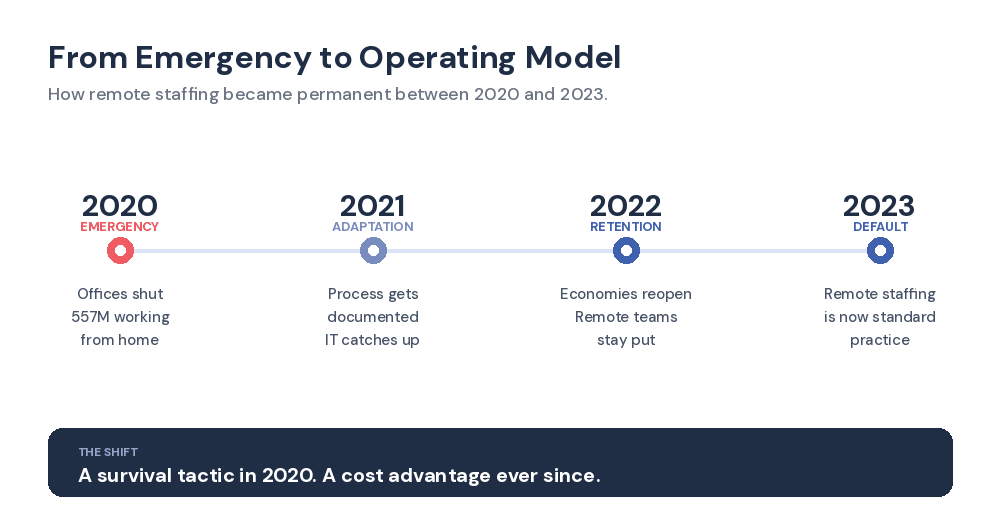
Almost overnight, Work From Home went from a perk a few lucky employees enjoyed to a survival strategy for entire industries. Employees stopped commuting. Businesses stopped putting their teams at risk. By the second quarter of 2020, the ILO estimated that 557 million people were working from home, roughly 17% of global employment, and more than at any other point in history.
As the old saying went: "Something is better than nothing." Work From Home wasn't perfect, but it kept productivity alive. More importantly, it protected lives, kept teams intact, and ensured companies could bounce back the moment the world reopened. By 2022, when most economies had returned to "normal," many of those habits had quietly hardened into permanent remote staffing policy.
Challenges on Both Sides
Working from home sounded simple in theory, but in practice, those first 18 months tested both employees and companies in entirely new ways. Some lessons came quickly. Others took years to fully understand.
The Employee's Struggle
Working from home blurred the line between professional and personal life. Without a defined workspace, distractions multiplied. Even the best-planned schedules struggled to recreate the daily rhythm of an office: focus, deadlines, structure, water-cooler conversations.
The Company's Challenge
For most businesses, the bigger crisis was infrastructure. Few were ready for an overnight remote shift. Secure servers, VPNs, laptops, software licenses, all of it became a bottleneck. Companies that lacked the IT setup to support a remote workforce simply couldn't operate.
Time & Productivity
Prioritizing tasks became harder when home responsibilities and work responsibilities collided in the same room. Carefully built schedules rarely survived a full week. Nothing was perfect, and every system had a loophole that took months to identify and fix.
The IT Bottleneck
The pandemic was a sudden, unprecedented event. Most companies had no stockpile of remote-ready equipment, which meant fewer employees could effectively work from home, even when they were ready and willing to.
The pandemic didn't create the future of work. It just forced us to live it, ten years earlier than anyone expected.
The Remote Staffing Solution
The pandemic generation, the founders and operators who built businesses in the middle of all that chaos, learned to be relentlessly optimistic. We are Millennials and Gen Z. We come from the modern era. We are optimistic by default. And we've always believed that for every problem, there is a solution waiting in plain sight. As the old saying goes: "If one door closes, another opens."
For thousands of businesses between 2020 and 2022, that other door was remote staffing. Three years later, it has become more than a workaround. It is now the default way smart companies grow.
Virtuality Became the New Reality
Outsourcing your work is the smartest way to do more with fewer resources. If your company is short on manpower, equipment, or office space, hiring a dedicated virtual employee means you skip the cost of infrastructure entirely. You define the task and the deadline. A trained professional delivers, every time. That model proved itself during the worst of the pandemic, and it has only grown stronger since.
From lead generation and web research to full-fledged remote staffing, Verito Assistance offers a wide range of virtual services that go far beyond simple administrative help. You can explore the full list on our services page, or read the full case for why founders hire a virtual assistant in the first place.
5 Lessons Remote Staffing Taught Every Business
Strip away the panic of 2020 and what remains is a playbook. These are the five lessons that outlasted the crisis, and they are exactly why remote staffing keeps growing even now that the world has reopened.
1. Infrastructure Is Optional
The businesses that collapsed were not the ones without offices. They were the ones that could not work without them. Remote staffing removes that dependency permanently, because your VA brings their own workspace, hardware, and connection.
2. Documented Process Beats Supervision
Teams that had written processes survived remote work. Teams that ran on tapping shoulders did not. Remote staffing forces you to document how work actually gets done, and that discipline pays off long after the crisis ends.
3. Talent Is Not a Postcode
Once work went remote, geography stopped deciding who could work for you. Stanford research later confirmed that remote schedules had no negative effect on productivity while cutting resignations by a third.
4. Fixed Costs Are a Liability
When revenue fell, salaries, rent, and equipment did not. Companies with variable cost structures rode it out. Remote staffing turns a fixed monthly burden into a flexible, pay-for-what-you-use line item.
5. Speed Beats Size
The winners were not the biggest companies. They were the fastest to adapt. Remote staffing lets you add capacity in days rather than months, which is the single most valuable thing a small business can buy.
Bonus: Trust Scales
The fear that remote workers would slack off never materialized. What mattered was clarity: clear deliverables, clear deadlines, clear ownership. Get those right and remote staffing works exactly like an in-house team, minus the overhead.
Remote Staffing FAQs
What is remote staffing?
Is remote staffing still relevant now that the pandemic is over?
How is remote staffing different from freelancing?
What does remote staffing cost compared to an in-house hire?
How do I start with remote staffing without disrupting my team?
Final Thoughts
The pandemic taught the world a hard lesson, but it also revealed a powerful truth: businesses don't need offices to operate. They need the right people, the right systems, and the right partner.
Three years later, that lesson hasn't faded. If anything, it has hardened into strategy. Remote staffing is now the foundation of how modern companies grow, faster, leaner, and more resilient than ever before.
Don't wait. Don't stress. Whatever your challenge, we have a solution. Contact us or send an email to [email protected] any time. We're available 24/7, just a door opening away.